 It was another cold and gray February day in Paris. Scarves were out and my dining companions and I were wrapped up like babies in a manger. However, to make up for the gloom, we were on our way to a three-star Michelin restaurant. A block away from the Musée Rodin, in the quaint yet posh 7th arrondissement of Paris, L'Arpège blends in with its surroundings, in an almost nondescript building if not for the restaurant's sign, to which you would have to look up to see. It's not exactly hard to find if you're on foot, but I can imagine that if you were driving, you might miss it. The neighborhood looks very uniformly shabby but chic, with the occasional visual shock of brightly colored doors.
Inside the restaurant itself, the decor is minimal and understated, with warm wood walls to emphasize an inviting and refined dining area which was simple and quietly elegant and which gave a white-tablecloth impression sans the stuffiness.
I understood the location and decor more once I tasted the food, or rather, I understood the latter once I looked back on the former; I suppose they're connected, so I can keep going in this circle. The meal was rigorously prepared but unobtrusively appealing. The courses were composed of clean-looking earth tones sometimes splashed with bold dashes of color, some of them even reminding me of a mosaic. This restaurant excelled at vegetables, like Agapé Substance where we had dinner a few nights before, and all of them come from Alain Passard's own kitchen garden.
First on the table, three types of amuses bouches, including pureed beets, pureed butternut squash and scallions, and cubed beets.


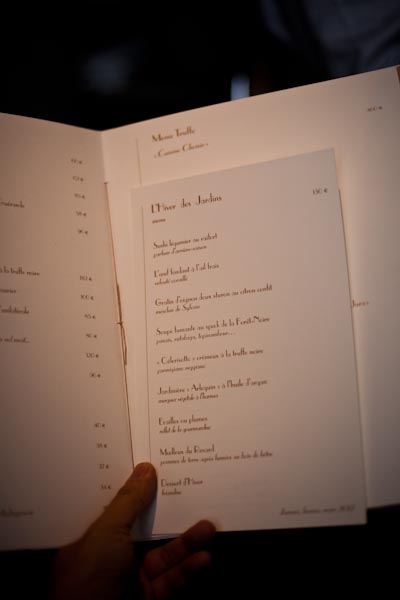
Regular menu and lunch degustation menu.


L'Arpège's interpretation of a sashimi, all vegetables and rice, even horseradish. So well made, I didn't even miss the fish.

Service was effiicient but engaged when needed. This was particularly welcome to us when it came to the wine. A Domaine Fontaine-Gagnard Chassagne-Montrachet, a great appellation from Burgundy and recommended by our wine guy (not sure if he was actually the sommelier), was one of the best wines of the whole trip. We were able to glean some information about it while quietly enjoying it, as well. A 2007 vintage, it was decanted for us. It had a floral bouquet and was slightly waxy in the mouth, reminiscent of a Condrieu crossed with a great Chablis--spectacular.


Poached egg (one theme of this gastronomic trip) with green garlic and velouté coraillé, suprisingly light and balanced; our friend who didn't eat eggs received some sensational vegetable dumplings in a simple but mind-blowingly delicious broth.


Gratin of finely grated sweet onions with mesclun de Sylvain; on the right, not cheese, but a wedge of butter. I had to have a taste just to make sure what it was.


Parsnip, rutabaga and sunchoke soup with Black Forest speck–smoked cream; "celerisotto" (made from celeriac) in cream with black truffles.


Root vegetables with argan oil and a vegetable "meguez sausage" with harissa, the most provocative and visually arresting piece of the lunch. The casing was admittedly that of an animal, but if sausages were made like this, I wouldn't mind skipping the meat.


To go with the meat dishes, another Burgundy from 2007, a Jacques-Frédéric Mugnier Clos de la Maréchale Nuits-St.-Georges half bottle. The wine was also tops, though I feel the main dishes it accompanied were the weakest part of the degustation. I had the duck, which was accompanied by a sour sauce, which logically would cut through the duck fat. But the duck was not fatty enough so the sauce was a little too acidic for my taste. I prefer the sauces in Asian restaurants, like those served with Peking duck, for example. Left, a Noix St. Jacques dish; middle, the duck dish; right, lamb with medallions of potatoes, batons of root vegetables and Brussels sprouts (or rather, one Brussels sprout). Not bad dishes per se, but comparatively speaking, not brilliant.


A Moelleux du Revard from Savoie served with a smoked potato.


A tray of friandises or petits fours, including beetroot and celery macarons; chocolate millefuille and cream with caramel sauce (millefuille caprice d'enfant).


We weren't extremely full, thanks to the predominance of vegetables in the lunch, about which we were content. So when an extra dessert appeared at the end, we were happy to oblige. This is one of their specialties, a tarte aux pommes in which strips of apples are formed into a bouquet of small roses.

Reservations are necessary and you can request them online from the restaurant's web site.
L'Arpège d'Alain Passard
84, Rue de Varenne
75007 Paris
+ 33 (0)1 47 05 09 06
arpege.passard@wanadoo.fr
View Larger Map
Comments
Post a Comment
Please keep comments clean and relevant to the article or discussion. The Dineocrat, in his infinite wisdom, will delete profanity-laced and irrelevant comments, as well as those with poor grammar.